Rocky Horror Hard!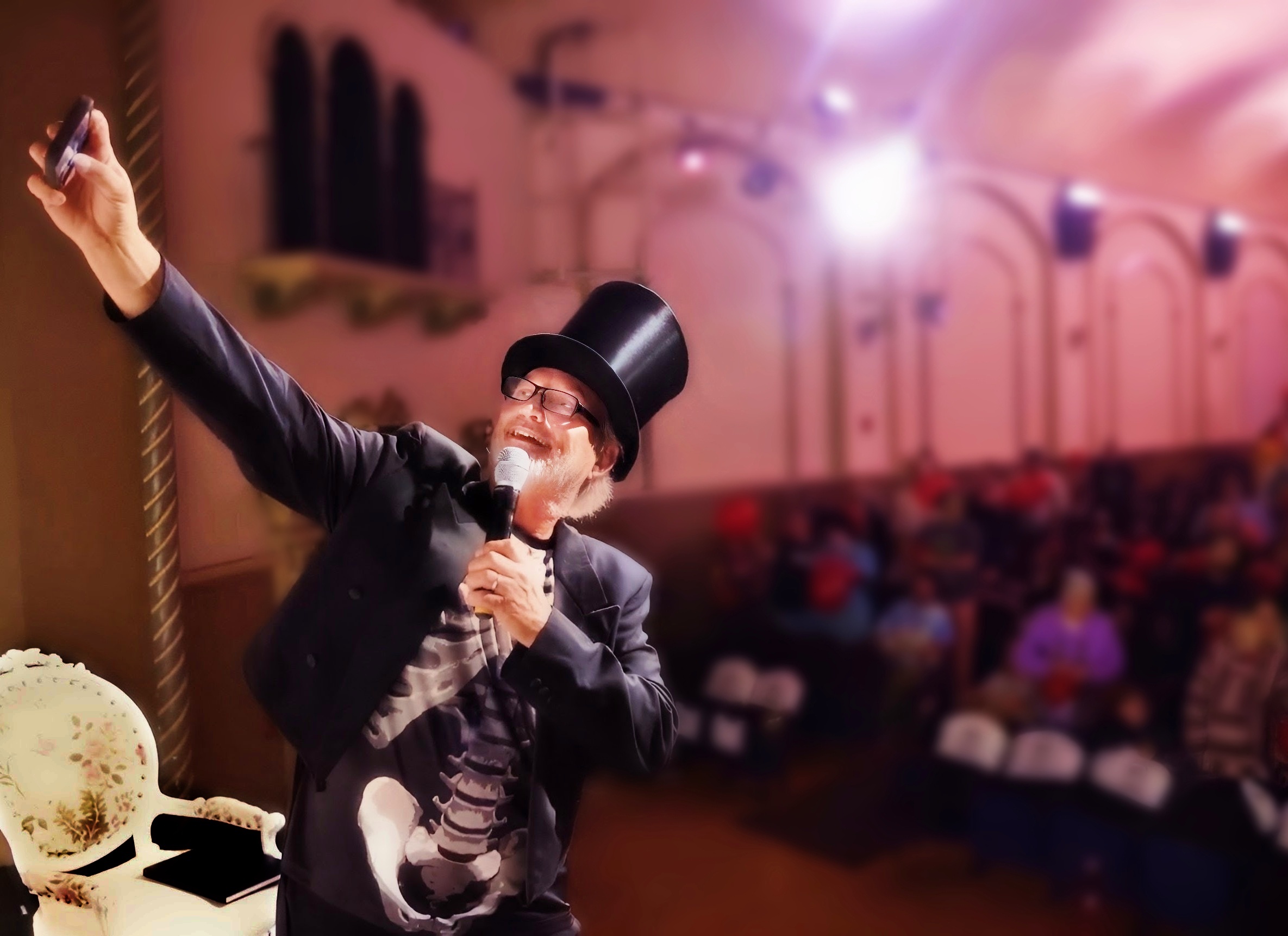
A Personal Journey Through
Parody, Pride, and Purpose
by Michael Baribeau aka Sweet Pea
Feb 28th, 2026
In the early 1980s, when I was a teenager, my brother and I went to one of the Rocky Horror Picture Show midnight movies in Grand Rapids, Michigan. I didn’t know anything about it except that he said we had to go in drag. We were just a couple of teenagers, and I was pretty naive, but my trust in him wasn’t misplaced. Our mom even helped us get ready. She picked out some of her clothes, did our makeup and nails, and stuffed a couple of her bras for us.
The movie was wild and funny, no shadowcasts but with interactive or audience participation throwing props like toast, shouting call backs, coming in costume with some getting up and miming a scene. But when we got home and realized we couldn’t wash off the nail polish, we both had a full blown panic attack.
At the time, it was just a strange, funny night. I had no idea that decades later Rocky Horror would circle back into my life in a much bigger way.
In 2015, friend and coworker Larry Selvage invited me and some of our other coworkers to a Halloween showing of The Rocky Horror Picture Show. I’d forgotten how fun it was. Larry, usually soft-spoken, surprised us all with his knowledge of outrageous callback lines that he shouted at the screen, making for a hilarious night. Afterwards Larry expressed his dream to start a shadowcast, (who dreams of starting a shadowcast?) and I said yes without fully knowing what that meant. By 2016 the next year he had founded the Grand Rapids shadowcast The Full Rocky and I was onstage as Brad for its inaugural show… with my parents and many of my family in attendance.
I also joined a Muskegon shadowcast founded by Kevin Kilbry, The Denton High Drama Club (the double entendre notwithstanding, it was an all-adult cast). It was there I was given the nickname/stage-name “Sweet Pea” while waiting for the theater to open for their first rehearsal. Some cast members and myself went to a convenience store next door for snacks. There was a friendly cashier who smiled and called each person “sweet pea”. However, when it was my turn, her smile went away and she only said, “You need to spend more than $5 to use a debit card.” I relayed this to my fellow castmates waiting outside which made Sammy Scrivener laugh so hard that she blew iced coffee out her nose, and Jamie Arnold-Page said I had just been christened “Sweet Pea”.
Over time I played nearly every role and later stepped into the position as Producer of a West Michigan traveling shadowcast, The Rocky Road Shadowcast (Formerly DHDC). What started as good fun became something far more meaningful. I wasn’t just performing in a cult classic. I was helping sustain a community. And the more time I spent inside the show, the more I began to appreciate how carefully constructed it actually is.
The Rocky Horror Picture Show began life as the stage musical The Rocky Horror Show and was conceived as both parody and loving homage to low budget science fiction and horror B movies. The opening song, “Science Fiction, Double Feature,” explicitly names many of these films, immediately signaling that the audience is entering a world built from cinematic references and exaggeration.
The plot follows classic horror structure. A young, engaged couple caught in a storm seek refuge in a strange mansion, directly parodying The Old Dark House. Like that film, Rocky Horror features an unsettling servant, a bizarre household, an awkward dinner, strange siblings, and overt theatrical menace, even down to the use of a gong.
Dr. Frank-N-Furter, portrayed by Tim Curry, first appears in a sweeping black cape and pale makeup that clearly evokes Bela Lugosi’s Dracula (1931). When the cape opens to reveal corset and heels, the film fuses vampire lore, mad scientist tropes, and camp provocation in one unforgettable entrance. Frank famously introduces himself as a “Sweet Transvestite from Transsexual, Transylvania,” layering parody, wordplay, and theatrical excess.
The term “transvestite” historically referred to cross dressing, but in popular culture it was often misapplied broadly to gender nonconformity, including drag performers and transgender people. Over time, the word has become widely experienced as outdated or offensive because it reduces identity to clothing and carries decades of stigma and sensationalism. In contrast, the now preferred “trans” and “transgender” emerged through community self definition and center gender identity rather than behavior.
Within traditional Rocky Horror audiences, queer and trans viewers generally understand the historical context and camp exaggeration of the song. When we perform for broader audiences, especially on Pride festival stages, we do not assume that context. We acknowledge the age of the film, its camp and parody intent, and our present day values. We perform it as celebration rather than caricature, emphasizing trans joy, visibility, and solidarity.
At its core, the film plays most directly with Boris Karloff’s Frankenstein movie (1931) parodied with alien invasion movies. Frank creates Rocky in a laboratory, echoing the Frankenstein’s monster’s birth. Rocky’s bandaged body recalls The Curse of Frankenstein (and The Mummy). The staged “marriage” nods to Bride of Frankenstein. Riff Raff functions as a warped Igor figure. Even references to Charles Atlas body building comic book advertisements and beach party films poke fun at exaggerated masculinity and body ideals. And there’s many more throughout the movie.
All of this excess was shaped by Richard O’Brien, an openly queer creator who intentionally blended horror, sci fi, sexuality, and theatrical camp into something both irreverent and affectionate. The film exaggerates older tropes that coded queerness as dangerous or deviant and flips them into spectacle. What once marked characters as monstrous becomes something magnetic, playful, and liberating.
Understanding these layers changed the way I performed the show. It was not random chaos. It was deliberate parody, cultural commentary, and joyful rebellion wrapped in fishnets and glitter.
Rocky Horror is not perfect. It is half a century old. Some of its language reflects another time. It was created by queer artists telling a queer story in a world that was often hostile and unsafe.
And yet, hostility has not disappeared. In recent years we have watched LGBTQ+ books pulled from schools, medically recommended trans care restricted or banned in some states, abortion protections overturned, and political leaders openly questioning marriage equality. Families like mine have had real conversations about contingency plans. My own son and his trans boyfriend have obtained passports out of fear that access to trans medical care could suddenly change.
That reality sharpens what this show means.
When Rocky Horror began in the 1970s, it offered a strange, glittering refuge. A place where queerness was not whispered but shouted. Where difference was not hidden but spot lit. That refuge still matters. Perhaps now more than many of us expected.
For years, as Producer, I focused mostly on logistics. Securing venues. Coordinating rehearsals. Hauling sets and props in a 6×12 trailer packed to the roof with corsets, lab coats, fishnets, and prop bags. I loved the antics and the camaraderie. I assumed that was the heart of what we were doing.
Then a Michigan based production studio Snowy in August approached us about filming a short documentary. When I watched the rough edit, I was surprised. It wasn’t only about the funny stories and applause. It was about impact. I listen to interviews by my LGBTQ+ castmates, seeing a different side to them. Friends I’ve known for years, speaking instead about finding belonging. About feeling safe. About being seen.
Somewhere in those conversations, I realized I had been thinking too small. I had been preserving a show. But I had not fully stepped into preserving what the show meant.
After the 50th Anniversary performance, we began moving more intentionally. We prepared dance numbers for outdoor Pride festivals in Muskegon, Grand Haven, and Grand Rapids. We sought rehearsal space in churches willing to open their doors for these winter time rehearsals. We invited new performers. We introduced context where needed. We performed with care, intention, and celebration.
Looking back at that teenage boy panicking over nail polish, I have to grin. What felt dangerous for a moment turned out to be harmless. What felt strange turned out to be freeing. What seemed like a wild midnight movie became a lifelong thread.
Today, when our cast takes the stage, whether in a theater or under a Pride festival sky, we are not just parodying old monster movies. We are carrying forward a space where fear can become laughter, where shame can become costume, and where difference can become applause.
We still do the Time Warp. We still shout the callbacks. We still rock the fishnets.
But now we do it with intention.
And we Rocky Horror hard.